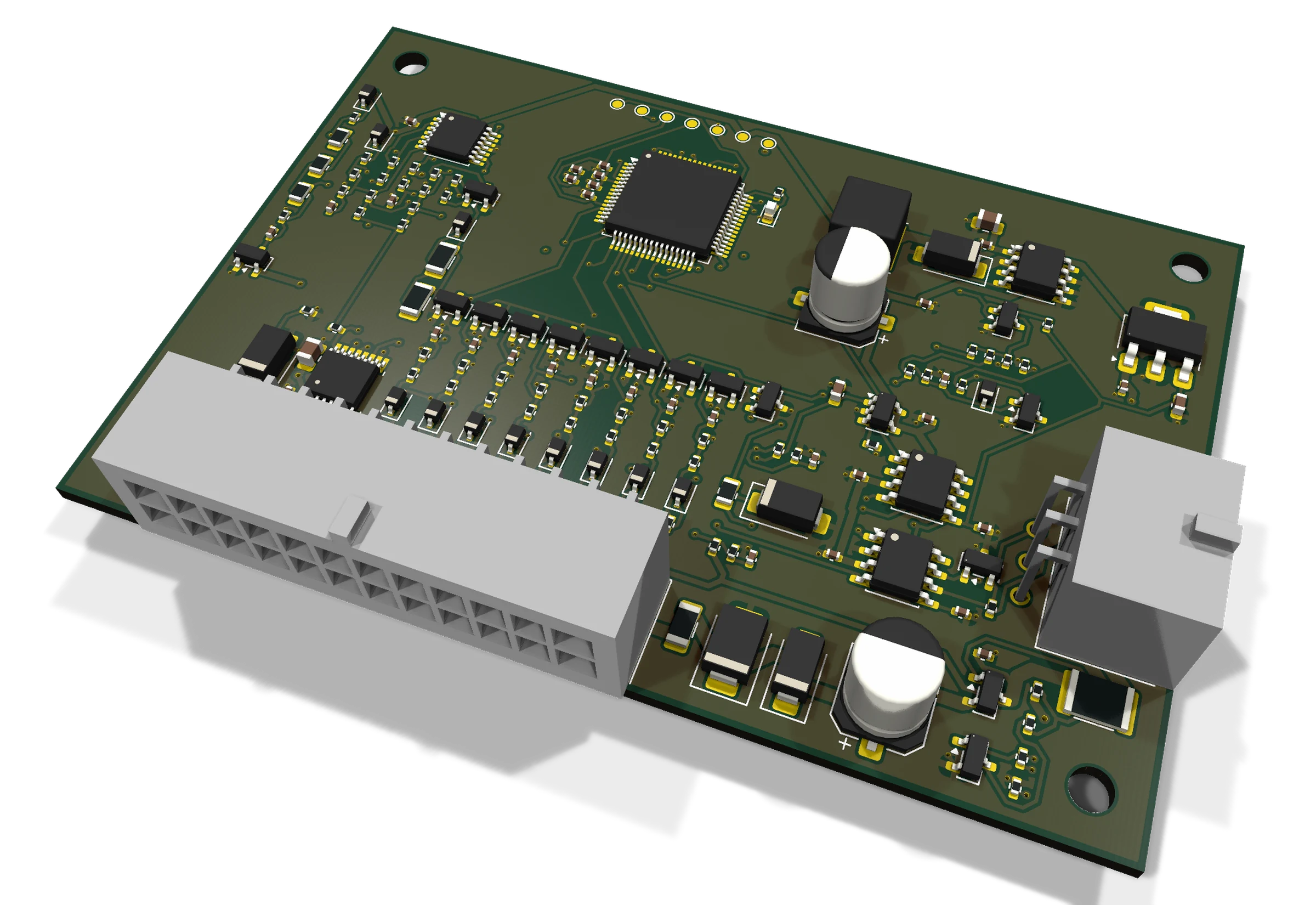
A render of the current board design. The plugs are simplified shapes. The finished hub comes in a housing.
How it fits
- Car to hub. One harness carries power, the OBD-II wires and your sensor and output wires. A plug-in OBD-II lead is planned, so most of the car side plugs in.
- Hub to gauges. The gauges plug into the hub, on their own network. They never connect to your car's network.
- The hub does the talking. It sends standard OBD-II requests, the same ones a scan tool sends, and passes the answers on. It doesn't change any settings in your car.
- Your own sensors. Add the readings your car doesn't report, such as oil pressure or gearbox temperature, and show them on the same gauges.
- Gauge 52 on its own. Direct OBD-II support is planned for Gauge 52 on cars with CAN OBD-II (most from about 2008), for the standard engine readings. The hub adds what the gauge can't do alone: older K-line cars, your own sensors and outputs.
Who it's for
- Cars on their factory ECU, when you want more than the standard OBD-II readings: oil pressure, extra temperatures, outputs
- Older cars with K-line OBD-II, or with no OBD-II at all, using your own sensors
- With an aftermarket ECU, you don't need the hub. Gauge 52 reads your ECU directly. Check yours.
Planned specifications
From the current design. They may change after prototype testing.
| Car data | OBD-II over CAN (most cars from about 2008). K-line, ISO 9141-2 and KWP2000, for many earlier cars. The older US J1850 systems aren't supported |
|---|---|
| Sensor inputs | 8 analogue inputs: 0–5 V sensors, resistive senders and thermistors (each input has a pull-up you can turn on), or switches |
| Pulse inputs | RPM and speed or frequency |
| Outputs | 4 switched-to-ground outputs, about 1 A each, for relays, fans, lamps and buzzers |
| Sensor supply | 5 V, current-limited, so a shorted sensor wire can't take the hub down |
| Gauges | One plug for power and data to your Gauge 52s |
| Power | 12 V vehicle supply, protected against reverse connection and spikes. Wakes with the ignition or car network; very low draw with the key off |
| Setup | Planned: choose readings and outputs from the gauge or in Gauge Studio |
| Size | Board 86 × 58 mm; housing to follow |
Questions
Will it work with my car?
If your car has an OBD-II port using CAN or K-line, the hub can read the standard engine data: RPM, speed, coolant and intake temperatures, throttle and more. What each car reports varies, so we'll publish a list of cars tested on real vehicles before launch. Your own sensors work on any car.
Can't Gauge 52 read OBD-II on its own?
That's planned. Gauge 52 is getting direct OBD-II support for cars with CAN OBD-II (most from about 2008), for the standard engine readings such as RPM, speed and temperatures. It's being tested before we list it. The hub is for everything else: K-line cars, sensors your car doesn't have, RPM and speed signals, and outputs. With the hub, your gauges also stay off the car's network.
Do I need it if I have an aftermarket ECU?
No. Gauge 52 connects straight to Haltech, MaxxECU, EMU Black, rusEFI and other ECUs that send data on CAN. See compatibility.
Is it safe to connect to my car?
The hub only sends standard OBD-II requests, the same as a scan tool, and doesn't change any settings in your car. Your gauges sit on their own network behind the hub, so they never connect to your car's network.
What sensors can I use?
Most common sensors: 0–5 V pressure sensors, the factory-style temperature and fuel senders that change resistance, thermistors, and on/off switches. Each input is set up for its sensor.
When can I get one?
There's no date or price yet. Gauge 52 comes first; the hub follows once prototypes are tested. Join the list for news. It's free, and it doesn't reserve stock or lock in a price.